ADF's make great aquarium pets, but fish aquariums are not always great for ADF's. We'll give you the info you won't get from aquarium experts, who know tropical fish, but little about these frogs..............

Monday, January 25, 2021

A Chilling Reminder to Keep Warm


Y
ou may have noticed, winter is full upon us! Baby, it's COLD! While we bundle up against the winter chill, it's a good idea to mention ways to make sure your Frogs don't have to contend with the cold. It's not like they can pull out some thermal undies, but there are steps YOU can take, to make things comfy cozy for them.


AVOID THE DRAFT!
No, not Uncle Sam, but rather drafts that chill you cold. Chilled air from leaky windows & doors, blowing upon your ADF Habitat can significantly lower it's water temperature far lower than the temperature in a room. You can avoid drafts by wrapping a towel around your tank, the trapped air in between the towel & the habitat makes for a good insulator.

GET AS HIGH AS YOU CAN!
Not in the way you think we mean... Place your ADF Habitat high up in a room. Top Shelf, overhead, up near the ceiling, because... HEAT RISES! The temperature in a room is always a few degrees greater up near the ceiling than down near the floor. So while your thermostat may read 70 degrees, it might be 72-73 up above while it's 67 down along the floor.
A smart suggestion would be to relocate the habitat to the kitchen...normally the warmest place in the house.
JUST BE CAREFUL! Getting High in the kitchen too often leads to the munchies.


AVOID AQUARIUM HEATERS!
Avoid the temptation of adding an aquarium heater to your habitat. While very handy for large aquariums, aquarium heaters cannot regulate the temps in smaller water containers at all, the sudden temperature fluctuations hot & cold can overstress a frog at least, at worse, turn your habitat into a piping hot bowl of Frogmore Stew.

The point here is that if the room is kept at a comfortable temperature between 65 to 75 degrees, there's NO NEED for a tank heater at all. If you keep cold drafts or hot furnace air from blowing on the tank, the TANK WILL BE AT ROOM TEMPERATURE. Then, if you have need to warm the tank further, there are EXTERNAL heating options available such as a space heater, or a desk lamp, or even a electric blanket that can provide heat.
The point is, you have NO RISK of a tank heater going bad is you DON'T USE ONE.

Best rule of thumb: If you are comfortable with the temperature in a room, your frogs will be comfortable. If you do need to add some short term localized heat, turn on a reading lamp with an incandescent bulb, and place it no closer than 6-10" away from the tank.

Bitter cold can be avoided with these simple steps, & by keeping room temps between 65-75 degrees, you AND your frogs will weather any cold snap! They be chilling, by NOT getting chilled out.


Wednesday, January 9, 2019

The Definitive Guide to Creating a Paludarium (Tank, Plants and Building Suggestions)

 Fishkeeping WorldA paludarium is an aquarium which has terrestrial plants as well as aquatic plants and aquatic life.
They are much easier to maintain in comparison to fully aquascaped aquariums, because they pretty much look after themselves if you choose the right plants and animal species.
You can include a much wider ranges of creatures in a paludarium than you can in an aquarium. As well as a whole range of freshwater fish you can also include shrimps, newts, crabs and even turtles.
In this article we’re going to take a look at what exactly a paludarium is, the plants and animals you can keep in one, how to build them and much more…


Thursday, January 3, 2019

Is there a Haze in your tank's water? Your Tank is Telling You Something

Here's a good topic to discuss, especially since it's been just over a week since Christmas, where many may have set up a brand new tank.
It's about time for newly established tanks to begin to show signs of the going on's within the water habitat. Water cloudiness is often the biggest indicator of how established your tank is.
The two main types of cloudiness in the water boils down to color... a pale milky color or a greenish tinge, both speak volumes as to the conditions in the habitat. For ADF's, one is of more significant concern than the other.
A whiteish colored haze in the water is indicative of excessive ammonia. While ADF's can tolerate ammonia far more than gilled fish, too much is too much and the tank's water needs a partial replacement to dilute the ammonia, but not a total replacement.
The reason for a partial replacement is to give the tanks bio-filter of anaerobic nitrifying bacteria some ammonia to digest. For the bacteria to filter properly it needs ammonia to kickstart it's growth. Over time, as the bacteria culture increases, it's capacity to digest ammonia will increase accordingly. The white haze will eventually go away as the bacteria culture increases, and with it, the need to do partial water changes as well. Once the culture reaches it's peak development, it will stabilize the level of ammonia that's present in the water. There is always some ammonia present, but it's continuously being digested by the bacteria.
The other haze... the greenish tinge..., indicates something altogether different. It indicates the tank has a very efficient bio-filter with plenty of active bacteria, all digesting the waste ammonia & producing nitrates. The greenish haze is microscopic algae cells, A fast-growing invasive plant, living off the nitrates being produced. A greenish tint is a indicator of good health, it's unsightly, but still it shows that the tanks bio-filter is doing it's job. And there's a simple way to get rid of the algae bloom. Simply darken the water in the tank.


Algae is a plant that lives on three things... nitrates, water & UV light. Take away one of those three, Algae cannot grow. Since the tank will have nitrates & water, the solution is to limit the amount of daylight or any light that has UV. Without Ultraviolet, the algae cannot grow. 

But to handle excessive Nitrates, there still needs to be some plant life in the tank. Otherwise the level of nitrites will be overwhelming and harmful. So plant some aquatic, shade tolerant plants to do the job. Once the tank has plants to consume the nitrates, the water will clear right up.

Wednesday, December 31, 2014

Combating "Conventional Wisdom" with Common Sense

EDITORS NOTE: With the start of the New Year, we thought to reprise an article we published previously. It's certainly good to do so, so that all the new African Dwarf Frog owners who just got their Christmas present, and are seeking out information may be able to find it. 
Anyone searching the internet about African Dwarf Frogs will soon find the following "Conventional Wisdom" in one form or another...

"...Typically, one frog for every 1 or 2 gallons of water is ideal...."

Ideal for WHO? The frog? Or the person selling Aquariums larger than 1-2 gallons?  Many websites seem to follow this common misconception without any real explanation, other than a misguided human emotion that these frogs wouldn't like  confined spaces.  

There's no scientific rationale behind requiring 1-2 gallons per frog.  It's a line of logic for setting up a standard aquarium, and taking in consideration of the needs of fish, who naturally need space to swim, and sufficient amounts of oxygenated water to breathe. Neither of which the species of African Dwarf Frog require. However, 1-2 gallons per frog would be good if you are setting up a unfiltered tank like a Goldfish Bowl... you'd then only have to change the water around every two weeks or so.
No oily skin...

In nature, African Dwarf Frogs only have need of water to keep their skin supple. ADF's do not produce a skin mucus which enables them to emerge out of water onto land like other amphibians, that's the only reason they are fully aquatic. Other than that, they could live in water which can merely keep their skin moist. Of course, they can be at home in larger water volumes, but as for a NEED to have such... emphatically NO!

A more critical water need for this species is WATER DEPTH. Most specifically, THE LESS THE BETTER...

ADF Ancestral Home
In nature... such as in the Rainforests of Cameroon in West Africa, the African Dwarf Frog evolved in shallow rainforest swamps, in a habitat of stagnant low-oxygenated water, in water depths of 8 inches of water or less. Unlike gilled animals such as fish, ADF's breathe air with lungs, and go to the surface to gulp air. As a bottom dwelling creature, the frog subsists quite well in shallow water depths which give them a quick trip to the surface to breathe. Put them in an environment where the water depth is deeper, the frog can survive, but the longer trip to the surface for air is more stressful, and in the wild, would present more exposure to the frog from predators. In a natural environment, you would not find these frog in deeper water than a foot. 
The idea that these frogs need a lot of space, is also a misconception. African Dwarf Frogs main roles in life is simply to eat, avoid getting eaten, and make more frogs. In nature, it's behavior is dictated by instinct & environment, which again, in nature would be in the muddy bottom of a rainforest swamp.
Here's lookin' at you... I think!
The frog is a natural wait & pounce creature in the method of acquiring it's meal. The African Dwarf Frog has very poor eyesight, a heightened sense of vibrations in the water, and a keen nose to smell out food. You may have seen these frogs in a familiar "Zen Pose" standing motionless. This is a evolved trait of still stalking, waiting for something, like a tasty water bug to wander by. It also is a defensive posture that helps make them invisible to larger predators. Unlike fish, ADF's don't school & swim seeking food, preferring instead for food to come to them. Kinda like a aquatic couch potato. They do not migrate, & they do not have a extensive range, except along the shallows of whatever shallow pool of water they'd inhabit.

Remember, when searching the web, seeking out information about African Dwarf Frogs (or ANY topic) there is tons of "Conventional Wisdom" out there... some accurate, some simply a regurgitation of other information posted elsewhere, without much foundation of fact. It sounds right, but really... is it really right? If you have questions, count on us to help give you answers. Our wisdom isn't always conventional, but at least count on it to be grounded in fact.

Tuesday, September 9, 2014

The Maternal Instinct

When a Mother Doe was killed by an Auto, leaving a young fawn orphaned, this nursing Chocolate Lab was happy to fill in. It's very common for normal behavior to be set aside when the maternal instinct kicks in.

Tuesday, August 26, 2014

Peterson Farm Bros Reap a Great Harvest in Parody


It's not often farming gets in the cultural spotlight. That's why it's refreshing to see three brothers on a Kansas farm grow a huge fan base following on youtube, with their parodies of popular songs.The Peterson Farm Bros video page draws millions of views of their well produced parody videos which are just as tasty as the beef they produce.

Friday, August 22, 2014

Freaky Friday Foto: The Milk Frog

Unless you are lactose intolerant, you will love this croaker...
No it’s not just the color which gives them their name, but it’s the milk-like poisonous fluid excretion released from them when they are stressed or threatened. They are native to Amazon rainforest and were first discovered in Brazil’s Maracana River. They are famously known as Amazon milk frog.
They are fairly large frogs, reaching up to 2.5- 4 inches. Females are startlingly larger than males. They are greyish in color blended with black banding. During their early stage of life, they have soft and supple skin, but with age they start developing bumpy texture and the grey color slowly metamorphoses to silvery white. Their mouths are tinted with blue, as if it’s chewing a mint; therefore they are also known as blue milk frogs. The milk excretion helps them deter predators and also help them to be hydrated. READ MORE

Tuesday, August 19, 2014

Frog Calls

THIS IS JUST TOO COOL!
The great folks at the University of Michigan has set up a really neat website for those of us who love frogs.
Ever heard the sound of the Poison Dart Frog? Here's your chance! Check out their Frog Calls page. You'll find sound clips of Mr. Dendrobates auratus, and many more, with links to further information for each. This is a great webpage to refer to when you hear the sounds of frogs in the night. You'll know in flash what frog is singing, and a whole lot more! Check it out & GIVE A LISTEN!

This brand new species of tree frog is already in trouble

Boophis ankarafensis, a new species of tree frog in Madagascar. (Gonçal
Washington Post Article
Tree frogs are adorable, so let’s have some more: In a study published in open-access journal ZooKeys, researchers describe a new species called Boophis ankarafensis. Unfortunately, it's in danger of losing its habitat.
Green with red speckles, the species looks quite similar to its closest relatives in the habitat – the banks of two streams in the Ankarafa Forest of Madagascar. But in addition to a large genetic divergence (one of more than 4.9 percent, based on analyzed gene fragments) the little frogs have one big distinction: Their call. (READ MORE)

Friday, August 15, 2014

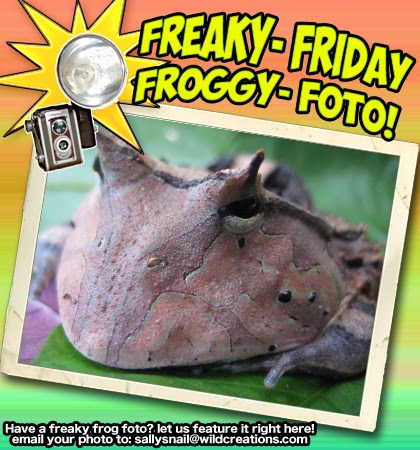
Freaky Friday Foto: The PACMAN Frog

Sporting a mouth as big as the great out doors, meet Ceratophrys, AKA The South American Horned Frog or...(drum roll)... The PACMAN Frog!
These big mouth frogs are voracious eaters, often eating insects, small mammals (such as mice), fish, other frogs, and small reptiles. A fully grown female Argentine Horned Frog (females are generally larger than males) can easily eat a grown rat. Also known to be cannibalistic, and have been known to eat their mates. Although these frogs can swallow animals almost half their size, they sometimes attempt to eat things larger than they are. A row of sharp bony projections in their upper jaw makes it nearly impossible for them to release prey after taking it in their mouth, in some cases leading to death by choking. Count all your fingers & toes if ever you get around one of these guys, just in case.

Freaky Friday: AugDEmented Reality

If this isn't perfect Freaky Friday material, I don't know what is...

Wednesday, August 13, 2014

French TV has AMAZING Animals

With the help of some neat computer generated special effects.

Monday, August 11, 2014

Happy World Lion Day

Conservationist Kevin Richardson, also known as the Lion Whisperer, wanted to film a PSA about lion conservation for World Lion Day on Aug. 10., but his companion proves what WC Fields once said... "Never work with kids or animals."

A World Unto Thier Own

We get questions from time to time, asking why we advise against keeping fish & frogs together in a standard Aquarium setting. While African Dwarf Frogs are a popular addition to freshwater aquariums, it's not always a good thing for either the fish, or the frogs.

Too often, the choices of what species are together in a tank, is determined by owners preferences, often whether a fish is pretty or cute or even how "happy" a critter seems when seen in a pet
Oooo! There's one that matches the wall paint!
shop tank.
  Unfortunately, a tank owners personal preferences is the WORST yardstick to use. The compatibility of different species should ALWAYS be considered over anything else. Always consider the type of fish species indigenous to the natural habitat of the frog... In other words, if you have African Dwarf Frogs, ALWAYS choose the species of tropical fish that are also indigenous to West African rain forests over all others.  Why?

Because eons of evolution has naturally selected fish & frog species to tolerate diseases carried by each species, who have evolved together in the same regional environment. A frog evolved in West African Rain forests, may not have tolerances of disease vectors carried by tropical fish from South East Asia or elsewhere. 
Hey! This oriental food is pretty tasty!
Equally important, is natural behavioral traits of each species, imprinted by location and circumstance, which are now instinctive.  While species may have naturally tolerant behavior regardless of where it evolved, some may have behaviors that will clash or compete with a foreign species, all because of where each species evolved from, and the environment each evolved in.

 Regardless if animals are bred in captivity or in the wild, evolutionary behaviors & physical tolerances do not radically change. Disease susceptibilities within a species still reside, whether bred in the wild or in captivity,  & there are cases where the presence of a foreign species can actually create susceptibilities which would normally not be present.

Bloat, (Dropsy) is a good example.  There's still no conclusive reason why ADF's lymph nodes are triggered to overproduce lymph fluid. Some suspect a reaction to a common bacterium, often found within the skin layer of tubal worms, like blood worms. Yet exposure to this bacteria in nature seldom shows ill effects. Bloat is not a common disease in nature, not near as common as it is in aquariums. However, there's evidence that ADF's sharing an aquarium habitat with fish, have a higher susceptibility rate than do ADF's who do not. One conclusion would be that something common with some fish species may tie in with exposure to the bacterium, which normally would not pose a problem, since intermingling to such species would never happen in the wild.  Another conclusion may be environmental factors, common within a fish friendly habitat, such as higher dissolved oxygen content in the water, can cause abnormal susceptibilities in African Dwarf Frogs, or a more tolerable environment for the bacterium to thrive & concentrate.
Remember, frogs can coexist with fish in an environment tolerable for fish, yet in a natural environment of extreme acidic, nitrate high, & low oxygenated water, fish are not a common species to co-exist with these frogs. Most fish cannot tolerate water conditions these frogs would call home. It's entirely the reason that in a more pristine aquatic world of a freshwater aquarium, species of fish & frogs which naturally never be together do intermingle, and present possibilities that never would happen in the wild.
These are the reasons we run contrary to conventional wisdom, and advise keeping fish & frogs separate in a aquarium environment. Doing so allows maintaining a tank ecology most suited to the needs of a species, while keeping the likelihood of cross species contamination & behavior conflicts totally eliminated. 

Friday, August 8, 2014

Freaky Friday Foto: Mexican Burrowing Toad

Kicking off a new feature to the blog, The Freaky Friday Froggy Foto! Our first photo is not of a frog, but a TOAD! A Mexican Burrowing Toad (Rhinophrynus dorsalis) . While it could be the poster child for a weight loss clinic, the Mexican Burrowing Toad only puffs itself up when threatened. Find out more here.

Thursday, August 7, 2014

Why not a Frog Instead of a Mouse?

While searching the internet for any topic which featured a frog... (no kidding!)... we stumbled across old cartoons of "Flip the Frog" drawn by U.B. Iwerks. Anyone who knows animation history knows of U.B. Iwerks, the man responsible for the distinctive style of the earliest Disney cartoons. U.B Iwerks was also responsible for creating Mickey Mouse.
U.B. Iwerks drawing Mickey

Flip the Frog was Iwerks second most famous cartoon character. He appeared in the time when Iwerks started his own cartoon production company after a falling out between him & Walt Disney.

Despite a contract deal with MGM to produce cartoon comedy shorts, Flip the Frog never made a huge splash (pun intended), as Disney's Mickey Mouse, despite having the Iwerks animation magic and comedy so much a signature of early Walt Disney cartoons.

Guess lightning doesn't strike twice, and Flip the Frog has been relegated to the ash heap of animation history, a footnote in the life of a legendary pioneer of cartooning.

Still, check out Flip the Frog, in a early cinemacolor MGM short from 1930, which features Flip in a piano/violin duet, with a vaguely familiar Mouse.

Wednesday, August 6, 2014

What is "Smart?"

How often have you sat & watched your frog... they watching right back at you, and pondered just what is going on behind those pair of bready little eyes? You just know something is going on in there... there has to... but just what is it? What is it that determines what a little African Dwarf Frog perceives has anything to do with what we would consider as thought? Obviously, they have something... we see personalities, or what we perceive as personalities in them, or have you ever just figured that since these guys are just frogs, there's no way we can ever judge them to be intelligent?
A video of an octopus working out a escape from a boat has gone viral, and lends as an example of how something even more primitive as a frog can show some intelligence in problem solving.
So the next time you get that feeling you're being watched, and you turn around to see a pair of little frog eyes watching you. Don't be too surprised if he's sizing up you figuring out what you're working on. Maybe he can lend a hand? Heck he's smart enough to have you feed him, doesn't he?

Friday, July 25, 2014

Murphy's Law and Aquarium Habitats


Murphy's Law states: "Develop a foolproof system and only a fool will use it", while Aquatic Habitats are far from foolproof, there is commonsense engineering behind them that can make them almost maintenance-free. But there's times that makes us give pause as to how well Ol' Murphy and his laws can be right on the mark.

With anything involving living organisms, there are countless things can happen, all depending on outside influences.

"I was afraid my Frogs were getting too hot, so I placed then in front of the air conditioner... now they just sit there..."   Frogs are amphibian's, meaning they're cold-blooded, they depend on their environment temperature. If the environment is cold, amphibians become cold, and tend to hibernate...or die. African Dwarf Frogs were originally from the rain forests of West Africa, not a place commonly known for Air Conditioning. The Smart Thing: Keep your ADF Habitat within a moderately comfortable temperature of 70 to 80 degrees.

"I didn't think my frog was getting enough air so I took the lid off...now my frog's missing."
Oxygen that live plants produces, and habitat covers allow for plenty of air. A tank cover serves several functions...it keeps the dust and junk out, keeps water from evaporating too quickly...and keeps wayward frogs from exploring too far.


"I didn't use any gravel ...why is my water all cloudy and my frogs dying?" The "Ugly" gravel is the "third leg" of the entire habitats eco-system. The tank gravel becomes infused with beneficial anaerobic bacteria that increases the "filter" capability for a habitat Without it, it's be hard for an external filter to establish a healthy environment.
"I keep my aquarium in sunlight so plants can grow....why is my water green?" You'd think that aquarium plants needs needs lots of sun but that's not always so... most common aquatic plants thrives in indirect sunlight. Most importantly, too much sunlight can trigger an algae bloom, which can really muck things up. Keep your aquatic habitat away from the window sill & it'll do fine.

Happily, most of the problems that may arise can easily be fixed, and while there's always something that may come along that could be a real head-scratcher, with some commonsense, maintaining a happy, healthy habitat can be a snap.

Thursday, July 24, 2014

Frogs in Space!

This photo which circulated around the internet last fall of a frog, taking an unexpected flight via a rocket -- may seem unusual. But #rocketfrog, as the little guy has become known, is not the first amphibian to, with the help of some human ingenuity, get a little closer to the final frontier. Nor is it the second. Nor is it the third. NASA and other space agencies, in their zeal to test the effects of microgravity on different organisms, have sent many, many other frogs into space -- not accidentally, as was the case with this launch, but purposely. For science. 
The following is a brief a brief history of frogs in space. Frogonauts, if you will.  READ MORE
Get This 4 Column Template Here
Get More Templates Here